What Is Deep Learning? A Beginner’s Guide to Neural Networks
Deep learning is a specialized branch of machine learning that teaches computers to learn from data by mimicking the human brain’s structure. Instead of relying on hand-coded rules, deep learning systems use multi-layered artificial neural networks to automatically discover patterns, making them incredibly powerful for tasks like image recognition, speech processing, and natural language understanding.
At its core, deep learning is built around artificial neural networks composed of interconnected nodes (neurons) organized into layers. The “deep” in deep learning refers to the multiple hidden layers between input and output. Each layer extracts progressively more abstract features—edges in early layers, shapes in middle layers, and complete objects in final layers—allowing the system to solve complex problems with remarkable accuracy.
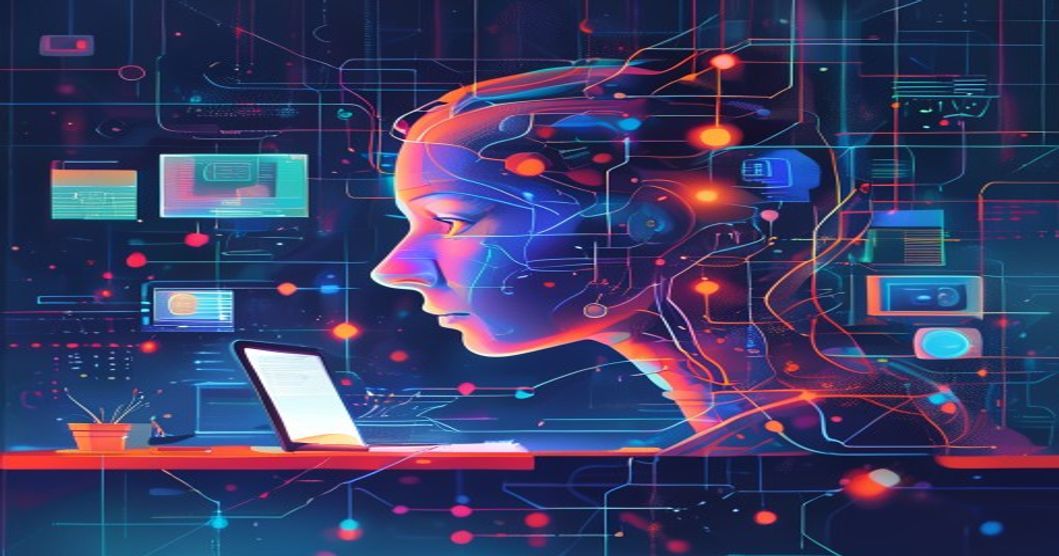
How Deep Learning Works
During training, data flows through the network (forward propagation), and errors are calculated against known outputs. The network then adjusts millions of internal weights using backpropagation and optimization algorithms like stochastic gradient descent. This iterative refinement continues until the model’s predictions become highly accurate.
Key Applications
- Computer vision: Facial recognition, autonomous driving, medical imaging
- Natural language processing: Chatbots, translation, sentiment analysis
- Generative AI: Creating images, audio, and text content
- Predictive analytics: Fraud detection, demand forecasting
Deep Learning vs. Traditional Machine Learning
Traditional machine learning requires manual feature extraction by experts, while deep learning automates this entirely. This makes deep learning more scalable but also demands significantly more data and computational power, typically leveraging GPUs and TPUs for efficient training.
Challenges and Limitations
- Requires massive labeled datasets to perform well
- Computationally expensive to train and deploy
- “Black box” nature makes decisions hard to interpret
Deep learning is transforming industries by enabling machines to perceive, understand, and generate content like never before. While challenges around data, compute, and interpretability remain, its ability to learn complex patterns makes it the driving force behind modern artificial intelligence.
